
How Shipping Zones Affect Dimensional Weight Fees
Shipping costs can quickly eat into e-commerce profits, especially when dimensional weight fees and shipping zones come into play. Here's what you need to know:
- Shipping Zones: Carriers calculate shipping costs based on the distance between the origin and destination, categorized into zones (1 to 8). Costs increase significantly with each higher zone.
- Dimensional Weight (DIM Weight): Charges are based on the package's size, not just its actual weight. Carriers use formulas like (Length × Width × Height) / DIM divisor to calculate this. The divisor varies: UPS and FedEx use 139, while USPS uses 166.
- Combined Impact: A lightweight, large package shipped to a distant zone can cost several times more than its actual weight suggests.
Key Takeaways:
- Packaging Matters: Using appropriately sized boxes can reduce DIM fees by 10–30%.
- Fulfillment Locations: Placing warehouses closer to customers lowers zone-based costs by 20–30%.
- Rate Shopping: Comparing carrier rates ensures you get the best deal for each shipment.
By optimizing packaging, strategically locating fulfillment centers, and using rate-shopping tools, businesses can cut shipping costs and protect their margins.
How Dimensional Weight Works: The Hidden Rule Behind Your Shipping Rates
sbb-itb-ed0a9d1
The Problem: How Shipping Zones Increase Dimensional Weight Costs
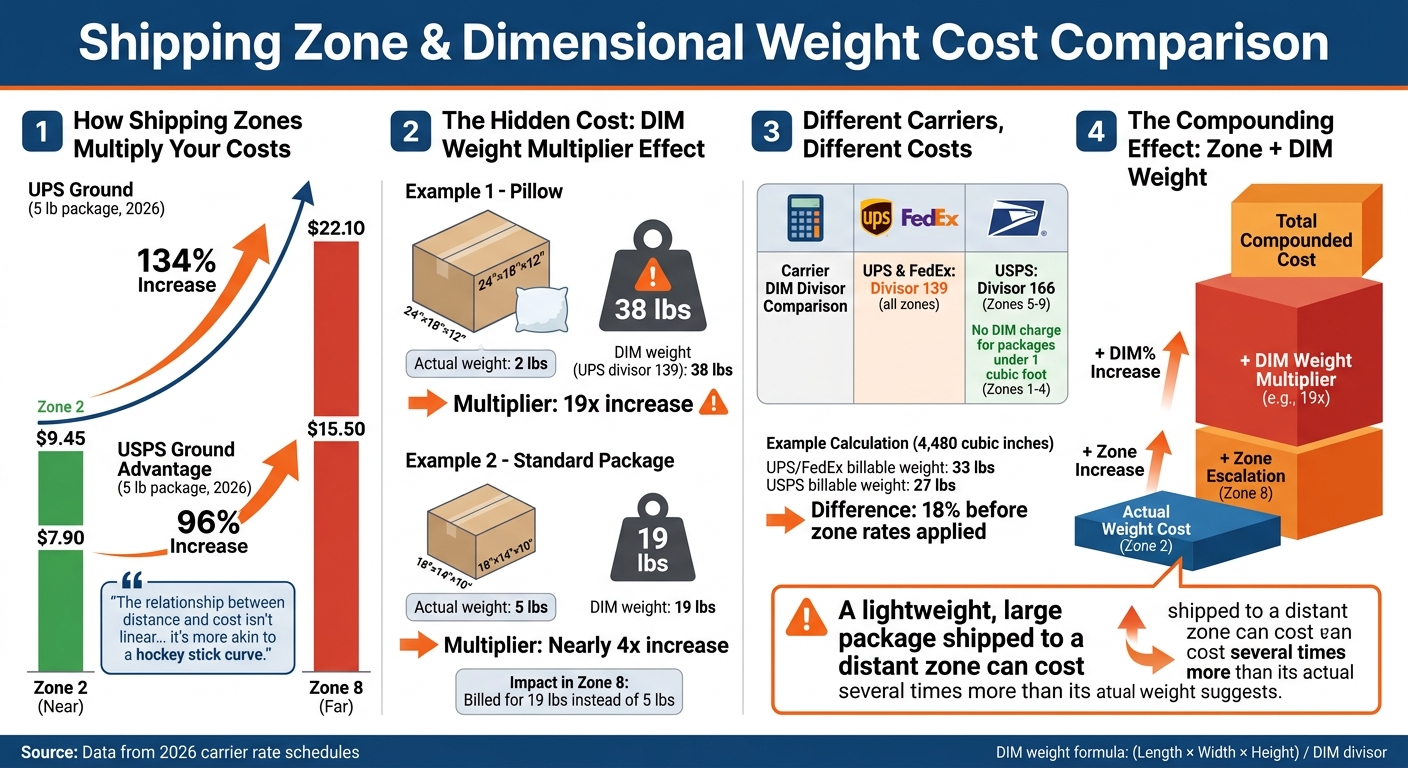
Shipping Zone Cost Comparison: How Distance and Dimensional Weight Impact E-Commerce Shipping Fees
Shipping zones and dimensional weight fees don’t just add to your expenses - they magnify them. When a package with a high DIM weight is sent to a far-off zone, the combined effect can quickly eat into your profit margins. Let’s break down how these factors stack up.
Zone-Based Pricing Multiplies Costs
Shipping carriers calculate rates based on zones, and the further the zone, the steeper the cost. What’s more, the rate increases aren’t linear - they accelerate as the zones climb. For instance, shipping a 5-pound package via UPS Ground in 2026 costs about $9.45 to Zone 2, but that skyrockets to $22.10 for Zone 8 - a 134% jump. USPS Ground Advantage follows a similar trend, with prices rising from $7.90 in Zone 2 to $15.50 in Zone 8, a 96% increase.
"The relationship between distance and cost isn't linear as one might expect; it's more akin to a hockey stick curve." - atoship
Now, imagine these rates being applied to the inflated billable weight of a package calculated using dimensional weight. The costs can escalate even further.
When Dimensional Weight Exceeds Actual Weight
Dimensional weight (DIM weight) creates another layer of expense, especially for lightweight, bulky items. Let’s say you’re shipping a pillow in a 24″×18″×12″ box. While the actual weight is just 2 lbs, the DIM weight comes out to 38 lbs when using UPS’s divisor of 139. That’s a 19x increase over the actual weight. Essentially, you’re paying for 38 lbs, not 2 lbs.
The situation gets worse when you factor in distant zones. Take an 18″×14″×10″ box with an actual weight of 5 lbs. Its DIM weight rounds up to 19 lbs. If you’re shipping this box to Zone 8, you’ll be billed for 19 lbs instead of 5 lbs, nearly quadrupling the cost.
How Carriers Use Different DIM Divisors and Zone Rates
Adding to the complexity, each carrier uses its own rules for DIM weight calculations and applies varying zone rates. For example:
- UPS and FedEx use a divisor of 139 across all zones.
- USPS applies a divisor of 166 for Zones 5-9 and doesn’t charge DIM weight for packages under one cubic foot in Zones 1-4.
Here’s how this plays out: A box with 4,480 cubic inches has a billable weight of 33 lbs with UPS or FedEx, but only 27 lbs with USPS - an 18% difference before zone rates are added. For shipments to Zones 1-4, USPS’s exclusion of DIM weight for smaller packages can lead to major savings. But for coast-to-coast deliveries (Zones 5-9), all carriers charge DIM weight, and the combination of high billable weight and steep zone rates can drive costs through the roof.
"Dimensional weight isn't going away - it's becoming more complex." - ShippingRulesGuide
Solutions: How to Reduce Dimensional Weight Costs Across Shipping Zones
Cutting down on dimensional weight costs involves using the right packaging, strategic inventory placement, and leveraging advanced technology. These approaches can lead to savings of 10-30%.
Use Right-Sized Packaging to Lower Dimensional Weight
One of the easiest ways to avoid paying extra for dimensional weight is to avoid shipping empty space. If your packages have more than 40% void space, you're likely overspending. By using 3-5 optimized box sizes instead of a single "one-size-fits-all" box, most D2C brands can handle 90% of their orders more efficiently.
"If your boxes are bigger than they need to be, you're literally paying to ship air." - TruePack Global
For example, a supplement brand shipping 8,000 orders monthly saved $177,000 annually by switching from a single 12″×10″×8″ box to a three-box system (8″×6″×4″, 10″×8″×5″, and 12″×10″×8″). Previously, they used a box with a DIM weight of 6.9 lbs for products averaging just 1.2 lbs. By reallocating 65% of orders to smaller boxes, they saved an average of $1.85 per order. Tools like Navexa's box optimization software analyze product dimensions and suggest the best packaging to cut DIM fees.
But packaging is just one part of the equation - where you fulfill orders from matters too.
Place Fulfillment Centers Closer to Customers
Shipping costs increase by 20-30% with each additional zone. A two-node network, such as warehouses on both the East and West Coasts, can lower shipping costs by $1.80-$2.60 per shipment while ensuring 2-day ground delivery for around 80% of the U.S. population. Adding a central U.S. node boosts coverage to 92-95%.
The secret lies in inventory forecasting. Instead of stocking everything everywhere, focus on placing your top 20% of fast-moving products at regional nodes while keeping slower-selling items at a central hub. Navexa’s inventory tools analyze demand patterns and set reorder points for each location, ensuring you’re well-stocked where it matters most. If more than 40% of your shipments are currently heading to Zone 5 or higher, opening a second fulfillment center could be a smart move.
Use Multi-Carrier Rate Shopping Technology
Shipping rates can vary significantly depending on the carrier, zone, and package size. USPS, for instance, uses a divisor of 166 and doesn’t apply dimensional weight to packages under one cubic foot in Zones 1-4. Meanwhile, UPS and FedEx use a divisor of 139 across all zones. Multi-carrier rate shopping compares real-time rates from carriers like USPS, UPS, FedEx, DHL, and regional providers to automatically find the cheapest option for each shipment.
Meridian Goods, for example, cut their shipping costs by 13% in just eight weeks after adopting Navexa. By using Navexa’s consolidation flagging and rate-shopping features, they replaced two separate SaaS platforms.
"We replaced two SaaS subscriptions with Navexa and cut our per-order shipping spend 13% in eight weeks. The consolidation flagging alone pays for itself." - Dana Reyes, Head of Operations, Meridian Goods
Navexa’s automated workflows streamline order routing based on destination, weight, and delivery speed. The platform also identifies patterns for further savings and flags same-address orders from different sales channels, enabling you to consolidate shipments and save on label costs.
Case Study: Cost Savings from Optimizing Zones and Dimensional Weight
Before Optimization: High Costs from Dimensional Weight and Zone Fees
A retailer based in Texas was shipping 3,500 orders every month across the U.S. They relied on a single box size - 14″×12″×10″ - for nearly all shipments, despite most products weighing less than 2 lbs. Using the standard 139 divisor, the dimensional weight for this box was calculated at 12.1 lbs. This meant the carrier was charging for an extra 10.1 lbs of unused capacity per shipment.
To make matters worse, 62% of their orders were headed to Zones 5–8, primarily in the East Coast and Northeast. The average shipping cost per package was $14.80, leading to a staggering $51,800 in monthly shipping expenses. Compounding the issue, they used only one carrier, missing out on potential savings for residential deliveries, which added $1.90–$2.00 per shipment. These inefficiencies piled up, creating a clear need for change.
After Optimization: Lower Costs with Navexa
In January 2026, the retailer tackled these challenges head-on by adopting Navexa's box optimization and multi-carrier rate shopping tools. They introduced a four-box system with sizes of 8″×6″×4″, 10″×8″×6″, 12″×10″×8″, and 14″×12″×10″. This adjustment allowed 71% of their shipments to fit into smaller, better-suited boxes, reducing the average dimensional weight from 12.1 lbs to just 4.2 lbs.
They also added a second shipping node in Pennsylvania, which lowered their average shipping zone from 6.3 to 3.8. Navexa's rate-shopping engine further optimized costs by routing lightweight packages through USPS, which offered better rates for such shipments, while heavier packages were sent via UPS or FedEx based on real-time pricing.
Within just eight weeks, the retailer saw their average shipping cost per package drop by 14.5%, from $14.80 to $12.65. Monthly shipping expenses fell to $44,275, resulting in savings of approximately $7,525 per month - or around $90,300 annually. On top of that, Navexa's consolidation feature flagged 140 duplicate-address orders each month, saving an additional $1,200 by combining shipments.
This case highlights how strategic fulfillment changes can significantly cut costs by addressing dimensional weight fees and zone-based surcharges.
Conclusion: Managing Dimensional Weight and Zone Costs
Mastering dimensional weight and zone-based pricing is key to keeping shipping expenses under control.
Main Points for E-Commerce Businesses
Shipping fees are heavily influenced by the interplay between dimensional weight and zones. Large, lightweight packages sent to distant zones can quickly drive up costs. Carriers charge based on the greater of actual or dimensional weight, and shipping to higher zones, like Zone 8, can cost up to 110% more than shipping to closer zones like Zone 2.
One of the most effective ways to save is through optimized packaging. By adjusting box dimensions to fit products snugly, businesses can cut shipping costs by as much as 15–30% by reducing billable weight and minimizing wasted space. Pairing this with smart warehouse placement - such as operating fulfillment centers on both coasts - can significantly lower the percentage of shipments sent to costly Zones 6–8, from 35% down to just 8%. Additionally, using multi-carrier rate shopping tools ensures that each shipment is handled by the most cost-effective carrier.
These strategies form the foundation for how Navexa helps streamline fulfillment costs for businesses.
How Navexa Helps Reduce Fulfillment Costs
Navexa integrates these cost-saving measures into a single platform. Its multi-carrier rate shopping tool pulls real-time pricing from USPS, UPS, FedEx, and regional carriers, ensuring you always get the best deal. The platform’s AI-driven box optimization minimizes packaging size, cutting down on billable weight. Moreover, Navexa’s multi-location fulfillment system automatically routes orders to the nearest warehouse, reducing expensive zone-based fees.
"We replaced two SaaS subscriptions with Navexa and cut our per-order shipping spend 13% in eight weeks. The consolidation flagging alone pays for itself." - Dana Reyes, Head of Operations, Meridian Goods
With average shipping cost reductions of 10–15% across active accounts, Navexa provides a powerful solution for managing dimensional weight charges and zone costs. Having processed over 50 million packages for more than 2,500 brands, Navexa has proven its ability to make a measurable impact on fulfillment expenses.
FAQs
How do I find a shipment’s zone?
Shipping zones depend on the distance between the origin and destination ZIP codes. Major carriers like USPS, UPS, and FedEx use zone maps or rate tables to group ZIP codes into zones - Zone 1 being the closest and Zones 8 or 9 being the farthest. To figure out a shipping zone, simply refer to the carrier’s map or rate table and match the origin and destination ZIP codes.
When does USPS charge DIM weight?
When shipping with USPS, dimensional (DIM) weight pricing comes into play if a package’s dimensional weight is greater than its actual weight. This calculation is based on the package's size and weight, using specific divisors to determine the billable weight. DIM weight pricing is particularly relevant for larger, lightweight packages where the space they occupy matters more than their physical weight.
What box changes reduce DIM fees fastest?
The fastest way to cut down on dimensional weight (DIM) fees is by using smaller, properly sized boxes that reduce the overall volume compared to the weight of the items inside. Steer clear of oversized boxes that exceed dimensional limits, such as those over 30 inches or 2 cubic feet, as they often result in additional surcharges. Choosing box sizes that snugly fit your products is the most efficient approach to lowering these fees.
Ship your next order through Navexa.
Connect a store, buy a label, and see the numbers yourself.