
How Batch Picking Reduces Fulfillment Costs
Batch picking is a game-changer for reducing warehouse costs and boosting productivity. Instead of picking one order at a time, workers collect items for multiple orders in a single trip, cutting down on unnecessary walking and wasted time.
Key benefits include:
- 27% less travel distance and 23% less travel time for workers.
- 50%–75% of warehouse costs tied to picking are significantly reduced.
- Higher productivity: Workers pick 70–100 items per hour compared to 40–60 with traditional methods.
- Lower labor costs: Savings of $78,000 annually for mid-size operations.
- Fewer errors: Mistakes drop, saving $15–$25 per error in returns and customer service costs.
Batch picking works by grouping orders with shared items, using optimized routes, and sorting items after picking. Tools like Warehouse Management Systems (WMS), pick-to-light tech, and AI-driven models make the process even more efficient. By adopting batch picking, warehouses can handle higher volumes without adding staff or compromising delivery speed.
The Problem: Single-Order Picking Inefficiencies
Excessive Warehouse Travel Time
Single-order picking creates a cycle of unnecessary trips. When workers pick one order at a time, they often revisit the same locations repeatedly. For example, if ten orders all include the same high-demand SKU, the picker must make ten separate trips to retrieve it.
"If the same picker walks to the same aisle five times for five different orders, four of those trips are waste." - Bart Gadeyne, CEO & Co-Founder, Optioryx
The data paints a clear picture: pickers spend just 15% to 20% of their time actually picking items. The other 80% to 85% is lost to walking, searching, and confirmation tasks. This means that out of every hour, 40 minutes are spent walking, with only 20 minutes dedicated to pulling products. Over the course of a shift, the average warehouse worker covers 8 to 12 miles.
These inefficiencies are tolerable at low order volumes - say, 30 orders a day - but become a bottleneck when daily volumes hit 100 or more. Without a better approach, warehouses are left with two unappealing options: fail to meet fulfillment targets, add more workers, or compare Navexa vs ShipBob to see how intelligent optimization can help. The result is wasted time, increased labor costs, and heightened pressure on operations.
Higher Labor Costs and Lower Productivity
Labor, which represents 55% to 65% of warehouse expenses, becomes even more costly when workers spend most of their time walking instead of picking. Essentially, businesses end up paying for movement rather than output.
"When pickers spend most of their time walking instead of picking, you are paying for transit, not productivity." - Siddharth Sharma, Nventory US
For a mid-size warehouse with five pickers, this inefficiency adds up to $78,000 annually - or about $300 per day - just in walking costs. During peak seasons, overtime expenses pile up as operations scramble to meet deadlines like UPS's 3 p.m. cutoff.
Beyond the financial impact, walking 8 to 12 miles per shift leads to fatigue, which increases error rates, particularly in the latter half of shifts. Each mistake that reaches a customer can cost between $15 and $25 to resolve, factoring in return processing, re-shipping, and customer service time. These costs quickly add up, eroding profit margins and putting additional strain on the workforce.
sbb-itb-ed0a9d1
Batch Picking vs Single Order vs Pick List: See Who Wins
The Solution: What Is Batch Picking?
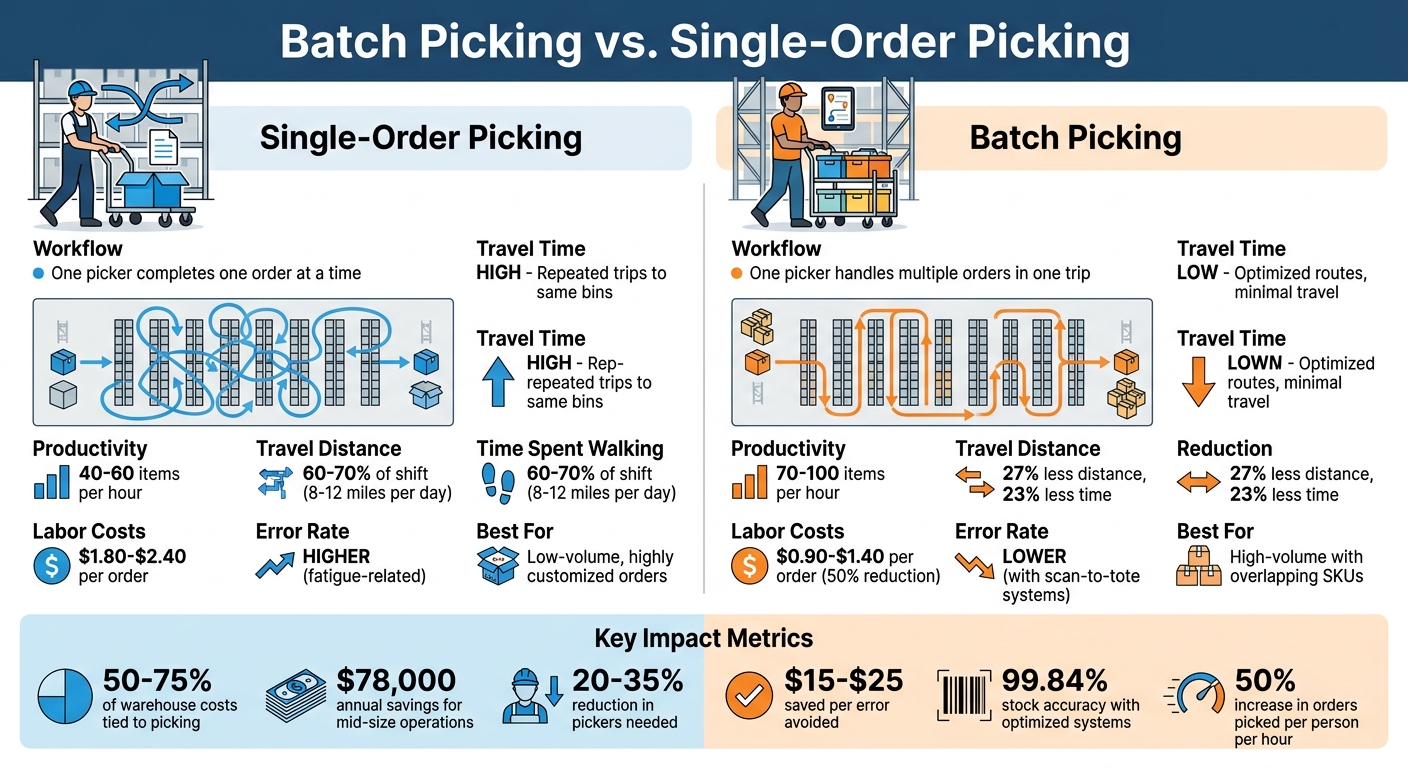
Batch Picking vs Single-Order Picking: Cost and Efficiency Comparison
Batch picking transforms the traditional single-order picking process by allowing warehouse workers to gather items for multiple orders during a single trip. This is done using a pick list that groups orders based on shared SKUs or the proximity of items within the warehouse.
Here’s how it works: A Warehouse Management System (WMS) groups orders with common items into a batch and creates an optimized route - often referred to as a "snake route." This route ensures the picker visits each bin location just once. Instead of making multiple trips to the same shelf for different orders, the picker collects the total quantity of each item needed for all orders in one pass.
Items are then placed into labeled totes or carts and taken to a put-wall for post-pick sorting. At this stage, items are distributed into individual customer orders. This sorting step is what sets batch picking apart from single-order picking, where each order is completed start-to-finish without consolidation.
By cutting down on repeated trips, batch picking reduces labor costs significantly. Since picking accounts for 50% to 75% of total warehouse operating expenses, minimizing unnecessary movement directly impacts the bottom line.
How Batch Picking Improves Order Fulfillment
Batch picking takes efficiency to the next level by streamlining both item collection and error prevention. Grouping orders with shared SKUs allows pickers to spend more time collecting items and less time walking across the warehouse.
Pickers follow the optimized route and place items into clearly labeled containers. To prevent errors - such as mixing up items between orders - many warehouses use scan-to-tote systems or put-to-light technology. These tools verify each item via barcode as it’s placed into the container. This reduces mistakes, lowers labor costs, and even cuts fuel expenses by eliminating unnecessary travel.
The results of batch picking can be dramatic. For example, using an AI-driven batching model can reduce travel distance by 27% and travel time by 23%. Additionally, upgrading to a logic-driven WMS has been shown to deliver 99.84% stock accuracy while increasing productivity. This translates to a 50% boost in the number of orders picked per person per hour.
And this isn’t just theoretical. In March 2026, streetwear brand CISE cleared a backlog of over 1,000 preorders in just 1.5 days by implementing an optimized picking process.
Batch Picking vs. Single-Order Picking
Here’s a quick comparison to highlight the differences between single-order and batch picking:
| Feature | Single-Order Picking | Batch Picking |
|---|---|---|
| Workflow | One picker completes one order at a time. | One picker handles multiple orders in one trip. |
| Travel Time | High, with repeated trips to the same bins. | Low, with optimized routes minimizing travel. |
| Labor Costs | Higher, due to inefficiencies at scale. | Lower, as throughput per hour increases. |
| Productivity | Lower, with more time spent walking. | Higher, with more focus on actual picking. |
| Sorting | Minimal post-pick sorting. | Requires sorting into individual orders after picking. |
| Best Use Case | Low-volume, highly customized orders. | High-volume environments with overlapping SKUs. |
Single-order picking might work well for low-volume or highly personalized orders, but it quickly becomes inefficient as order volume grows. Batch picking, on the other hand, is ideal for high-volume operations where many orders share similar items - think apparel, supplements, or small accessories. While it does add a sorting step, the time saved by reducing unnecessary travel more than makes up for it, especially when managing over 100 orders daily.
How Batch Picking Cuts Fulfillment Costs
Batch picking helps lower fulfillment costs by reducing time spent walking and trimming labor and equipment expenses.
Less Travel Time and Higher Productivity
Did you know that pickers spend about 60% to 70% of their shift walking? That’s a lot of wasted time and energy. Since labor is one of the biggest operational costs, every unnecessary step adds to expenses.
Batch picking solves this problem by cutting out redundant trips. Instead of making multiple visits to the same shelf for different orders, pickers hit each spot once and grab everything needed for several orders at once. This approach slashes travel time, boosting productivity and cutting costs.
The results? Big improvements in efficiency. Picks per labor hour can jump from 40–60 items to 70–100 items. That’s nearly double the output without hiring more staff.
"Picking is 50% of operational cost in a non-automated warehouse - reducing travel time is the fastest way to lower your cost-per-order." - Shopify Staff
For a warehouse handling 20,000 order lines weekly, optimized pick paths can save the equivalent of 3 to 4 full-time workers. Labor costs per order can drop from $1.80–$2.40 to just $0.90–$1.40, cutting costs by about 50%.
These gains in efficiency naturally lead to savings in other areas, like labor and equipment.
Reduced Labor and Equipment Expenses
With productivity on the rise, the need for labor decreases, and equipment experiences less wear and tear. Batch picking can reduce the number of pickers required by 20% to 35%. During peak times like Black Friday or the holiday season, some operations manage up to four times their usual volume without hiring temporary workers or paying for overtime.
Fewer trips also mean warehouse tools - like carts and scanners - last longer and require less upkeep. Plus, carts are used more efficiently, carrying full loads instead of just a few items per trip.
Reducing walking distance doesn’t just save time; it also lowers fatigue and error rates. Each picking mistake can cost $15 to $25 in returns and customer service expenses. By cutting errors, batch picking improves efficiency and protects profit margins.
Training new hires gets easier too. Batch picking instructions are system-generated and easy to follow, which shortens onboarding from 2–3 weeks to just 1–3 days. This streamlined process makes seasonal hiring faster and less expensive.
"A 35 percent reduction in walking distance saves $27,300 annually in labor alone [for a mid-size operation], before accounting for fewer errors and faster cycle times." - Siddharth Sharma, Nventory US
In short, fewer workers, reduced overtime, lower equipment maintenance, quicker training, and fewer errors all combine to make batch picking a powerful strategy for cutting costs and improving operations.
How to Implement Batch Picking
Mastering batch picking involves a mix of analyzing your current operations, integrating the right technology, and preparing your team to adapt.
Analyzing and Grouping Orders
Start by evaluating your warehouse’s picking performance. Measure productivity in terms of orders and lines completed per hour, while also tracking how far pickers need to travel. Pinpoint fast-moving SKUs and common order patterns. Look for bottlenecks, like excessive travel distances or inefficient zones, that could be slowing down fulfillment.
When grouping orders, consider factors like shipping deadlines (wave batching) or specific warehouse zones (zone batching) to distribute workloads evenly. You can also group by SKU similarities or orders with comparable values.
Batch size plays a big role in efficiency. For paper-based systems, stick to 8–15 orders per batch. With RF scanners, aim for 12–25, and for voice- or light-directed systems, batches of 20–40 are ideal. Use ABC analysis to place high-demand items (“A” items) closest to packing stations, cutting down on unnecessary walking.
"The warehouse walking pattern is one of the biggest hidden costs in fulfilment operations. When implemented correctly, batch picking can reduce travel time by up to 40%, instantly transforming your productivity without requiring expensive automation." - David, Business Director at PALLITE
Before rolling out batch picking across your entire operation, test it in a single zone or with a specific type of order. Run this pilot for 2–4 weeks, measure the results, and refine the process before scaling up.
Once orders are grouped and bottlenecks are addressed, technology becomes the next step in optimizing your picking process.
Using Technology to Optimize Picking
A Warehouse Management System (WMS) can automate order grouping based on SKU overlap, zone proximity, or shipping deadlines. It also calculates the most efficient pick routes to minimize travel time. For even greater accuracy, integrate tools like pick-to-light or scan-to-tote systems. High-volume operations can benefit from AI-driven tools that reduce travel distances by up to 55%, factoring in real-time variables like aisle congestion. Voice-picking headsets and mobile apps further enhance efficiency by providing hands-free instructions in real time.
Platforms such as Navexa can integrate with your warehouse systems to automate workflows, from order grouping to shipping. With connections to over 50 platforms and real-time analytics, Navexa can streamline operations and even cut shipping costs by 10–15%.
Before implementing new software across your entire warehouse, test it on a small scale. This approach helps you identify and resolve potential issues early.
After optimizing the picking process with technology, focus on training your team to use these tools effectively.
Training Staff on Batch Picking
Technology alone won’t improve productivity - it’s equally important to train your team thoroughly. Start with a mix of classroom-style instruction and hands-on practice. Cover the full batch picking cycle, including batch creation, optimized routing, and sorting after picking.
Make sure employees are comfortable with tools like WMS, RF scanners, mobile apps, and visual aids such as pick-to-light systems. Emphasize how these tools reduce physical strain and improve efficiency. Shadowing experienced pickers can also help new team members learn faster. Begin with smaller, simpler batches and gradually increase complexity as skills improve.
Establish clear standard operating procedures (SOPs) for tasks like batch release, handling exceptions, and verifying orders. Short daily briefings can help reinforce goals, address safety concerns, and review previous challenges. Encourage peer mentoring and hold regular feedback sessions to identify and solve process inefficiencies. Cross-training staff in picking, sorting, and packing ensures flexibility, especially during peak times.
"The most successful operations we work with view batch picking as an evolving process. They're constantly analysing data, making small adjustments, and testing new approaches." - David, Business Director at PALLITE
With proper training, your team can fully leverage new systems, boosting productivity and cutting fulfillment costs. By combining analysis, technology, and training, batch picking can become a long-term solution for improving warehouse efficiency.
Conclusion
Batch picking cuts down on the unnecessary travel that drives up operating expenses in warehouses. Repeated trips to the same bin for different orders can make up 50% to 75% of total warehouse costs. By consolidating these trips into one pass, batch picking reduces travel distances by up to 27% and travel time by 23%. This means higher throughput, lower labor costs, and fewer errors - critical improvements for managing fulfillment costs effectively.
Advanced picking systems also deliver impressive results, achieving 99.84% stock accuracy while increasing the number of orders picked per worker by 50%. For example, in March 2026, streetwear brand CISE managed to fulfill over 1,000 preorders in just 1.5 days by refining their fulfillment processes.
"Picking is 50% of operational cost in a non-automated warehouse - reducing travel time is the fastest way to lower your cost-per-order." – Shopify Staff
E-commerce businesses can now harness smart platforms to implement batch picking with ease. For the 70% of retailers grappling with rising fulfillment costs, batch picking becomes a game-changer when paired with tools like Navexa. This platform automates order grouping, optimizes pick routes, and integrates with over 50 systems. It also provides real-time analytics and can cut shipping costs by 10–15%, turning batch picking into tangible savings.
Whether you're gearing up for peak seasons or managing daily operations, batch picking ensures every step is efficient and every dollar is well-spent. By moving from single-order to batch picking, fulfillment centers not only address inefficiencies but also gain a competitive edge in the fast-moving world of e-commerce.
FAQs
When should I avoid batch picking?
Batch picking isn't always the best choice, especially when maintaining inventory accuracy is a challenge or when order volumes are low. In these cases, batch picking can lead to more picking errors and lower overall efficiency, which can hurt your fulfillment process instead of helping it.
How do I prevent order mix-ups during batch picking?
To cut down on order mix-ups during batch picking, it's important to stick to a few key strategies. Start by grouping similar SKUs together - this makes the picking process smoother and less confusing. Next, optimize the pick paths to save time and reduce mistakes. Clear, distinct labels on items are also a must to avoid any confusion.
Once items are picked, make sure proper sorting and packing systems are in place to keep everything organized. And don’t overlook the importance of keeping accurate inventory records - discrepancies can lead to costly errors.
By combining streamlined workflows, precise labeling, and dependable inventory tracking, you can significantly improve the accuracy of your order assembly process.
What batch size works best for my warehouse?
Choosing the ideal batch size depends on several factors, including your order volume, the variety of items you handle, and your warehouse layout. For high-volume operations, batch sizes between 5 and 20 orders often strike a good balance.
Here’s the trade-off: Larger batches can save time by cutting down on travel across the warehouse. But, they might also increase the likelihood of errors. On the other hand, smaller batches tend to improve accuracy but may slow down overall efficiency.
The key? Test different batch sizes and adjust based on how your specific operations perform. Fine-tuning this process can help you find the sweet spot between speed and accuracy.
Ship your next order through Navexa.
Connect a store, buy a label, and see the numbers yourself.