
How to Solve Urban Last-Mile Delivery Issues
Urban last-mile delivery is expensive and inefficient, making up over 50% of shipping costs. With rising e-commerce demand, businesses face challenges like traffic congestion, limited curb space, failed deliveries, and increasing customer expectations for reliability. Here's how to address these issues:
- Optimize routes using AI tools to cut delays and costs.
- Choose the right carriers and shipping platforms for urban areas, focusing on performance, micro-fulfillment centers, and eco-friendly vehicles.
- Set up micro-hubs to reduce delivery distances and costs.
- Use smart lockers to minimize failed deliveries and theft.
- Leverage data and automation to track performance, reduce inefficiencies, and improve customer communication.
These solutions can reduce costs, improve delivery times, and meet customer expectations while addressing urban logistics challenges.
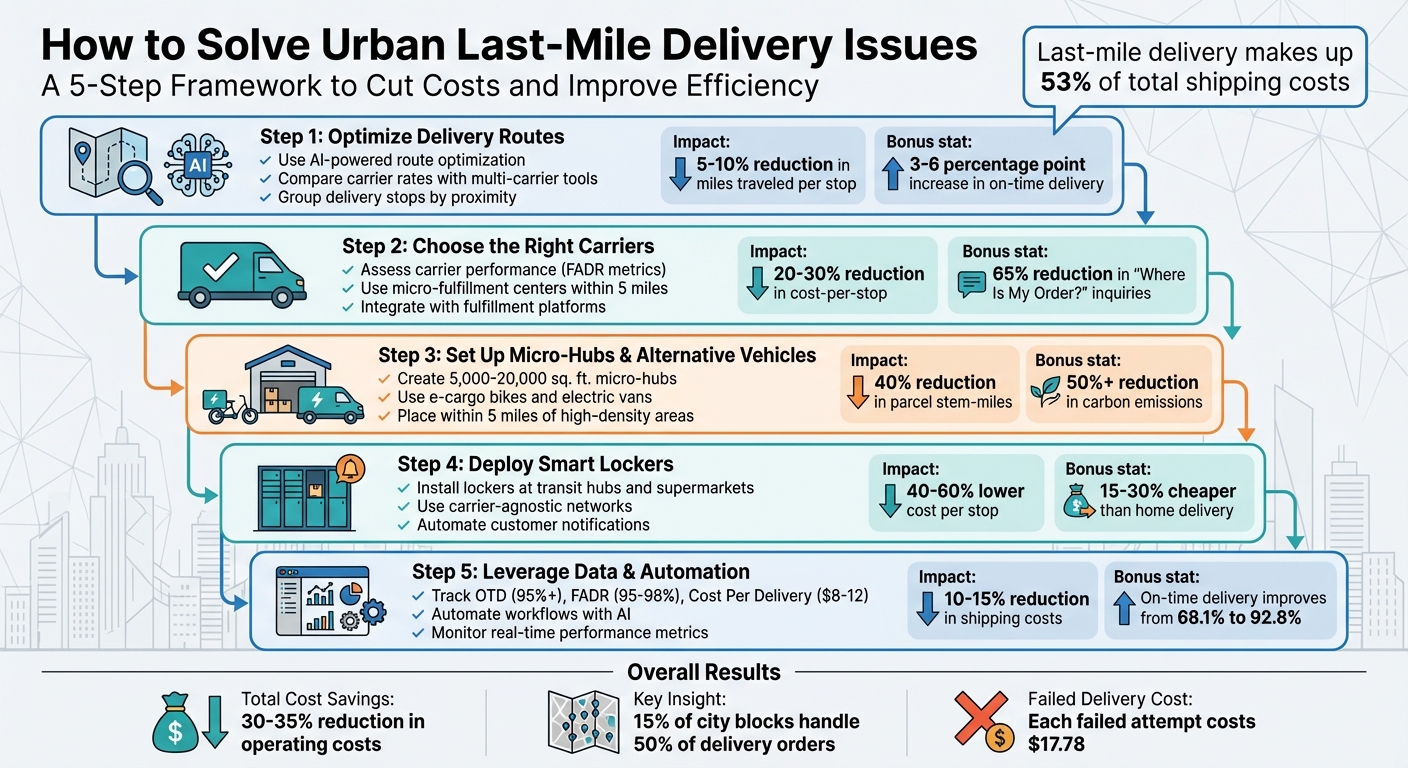
5-Step Framework to Solve Urban Last-Mile Delivery Challenges
How Can Urban Last-mile Delivery Be Optimized? - Smart Logistics Network
sbb-itb-ed0a9d1
Step 1: Optimize Delivery Routes to Cut Costs and Save Time
Urban deliveries often face challenges like traffic delays and rising shipping costs, making efficient route planning essential. Route optimization tools leverage AI to analyze real-time traffic, weather, and incidents, helping vehicles avoid congestion and delays. Unlike fixed routes, these tools dynamically adjust paths, guiding drivers around accidents, construction, or sudden traffic jams. By using geospatial clustering, businesses can reduce miles traveled per stop by 5–10%. These strategies form the backbone of faster, more cost-effective urban deliveries.
Compare Carrier Rates with Multi-Carrier Shopping Tools
Choosing the right carrier is another key step in streamlining operations. Multi-carrier rate shopping tools simplify this process by comparing prices based on package size, delivery speed, and destination. Tools like Navexa (https://navexa.co) integrate with over 50 e-commerce platforms, providing real-time rate comparisons that can lower shipping costs by 10–15%.
Group Delivery Stops and Analyze Traffic Patterns
After planning routes, grouping delivery stops by proximity and timing is crucial. By examining 12–18 months of GPS data, drop sizes, and timestamps, businesses can pinpoint high-density delivery zones. Organizing stops to avoid left turns in busy traffic and bundling deliveries for high-rise buildings can significantly improve efficiency. Using a rolling-horizon approach, routes are refreshed every five minutes to adapt to cancellations or road closures, increasing on-time delivery rates by 3–6 percentage points. This dynamic adjustment ensures smoother deliveries, even in unpredictable conditions.
Step 2: Choose and Optimize Carriers for Urban Delivery
Picking the right carrier for urban deliveries goes beyond just comparing costs. Carriers need to handle narrow streets, comply with zero-emission and noise rules, and efficiently serve crowded areas. Options like electric vans, cargo bikes, and scooters can navigate traffic jams and access pedestrian-only zones that larger trucks can't reach.
The choice of carrier has a big financial impact. Last-mile logistics make up 53% of total delivery costs. To cut expenses, look for carriers that use micro-fulfillment centers located within five miles of high-density areas. These compact facilities, ranging from 5,000 to 20,000 square feet, can reduce cost-per-stop by 20% to 30% and cut carbon emissions by over 50%. It's worth noting that in urban areas, just 15% of city blocks handle 50% of all delivery orders.
Assess Carrier Performance and Platform Integration
Keeping an eye on carrier performance is essential. Metrics like the First Attempt Delivery Rate (FADR) are particularly important since each failed delivery attempt in congested cities costs an average of $17.78. Analyzing on-time delivery rates by neighborhood or time slot can highlight recurring issues, such as traffic delays or challenges accessing certain buildings.
Seamless integration with your fulfillment platform can simplify operations. For example, Navexa (https://navexa.co) connects with carriers using APIs to standardize tracking data, providing a single source of truth for ETAs. This eliminates the need to juggle multiple carrier platforms and can reduce "Where Is My Order" inquiries by up to 65%. Carriers equipped with mobile apps that capture geo-stamped proof of delivery, photos, and e-signatures further enhance accountability and minimize disputes. These tools not only streamline operations but also improve communication with your customers.
Use Real-Time Tracking to Improve Customer Communication
Real-time tracking can transform the delivery experience by keeping customers informed every step of the way. GPS tracking with refresh rates between 5 and 60 seconds delivers highly accurate location updates and ETAs, with 99% precision. This level of transparency matters - 91% of consumers actively track their orders, and 84% are unlikely to return to a brand after a single poor delivery experience.
Automated alerts, like notifications saying "driver is 10 minutes away", can cut failed delivery attempts by as much as 40%. These alerts can integrate with existing systems without requiring extra hardware. For deliveries involving oversized or bulky items, carriers with specialized networks often provide two-person crews and scheduled delivery windows, ensuring a smoother process.
Step 3: Set Up Micro-Hubs and Use Alternative Delivery Vehicles
Last-mile delivery is notorious for its high costs, often accounting for 40% to 50% of total transportation expenses. To tackle this, combining micro-hubs with smaller, flexible delivery vehicles can make urban deliveries faster and more cost-effective. By strategically placing micro-hubs in high-demand areas and using agile vehicles, businesses can cut costs and navigate congested cities more efficiently.
Create Micro-Hubs to Improve Last-Mile Efficiency
Micro-hubs are compact distribution centers (5,000–20,000 sq. ft.) located within five miles of densely populated neighborhoods. These hubs consolidate shipments at the city’s edge, allowing smaller vehicles to handle the final leg of delivery. This setup can trim parcel stem-miles by 40% and reduce cost per stop by 20% to 30%. When paired with zero-emission vehicles, carbon emissions per order can drop by over 50%.
To get started, analyze delivery data from the past 12 to 18 months to identify high-demand zones using heat maps and optimize your shipping strategy. Use ABC velocity analysis to stock the fastest-moving SKUs - those appearing in at least 1% of same-day orders. Look for spaces like vacant retail stores, parking garage mezzanines, or prefab pods with short-term leases (under five years). Choose locations with ground-floor access, nearby bike lanes, and enough power capacity for EV charging.
For example, the City of Toronto and Purolator ran a micro-hub pilot from 2022 to 2024 using a repurposed 40-foot shipping container at the University of Toronto’s downtown campus. This project showed that a single cargo e-bike could replace a traditional delivery van without losing efficiency, leading to the hub’s permanent establishment in June 2024. Similarly, UPS launched a Hamburg pilot in 2015, using small storage containers as micro-hubs. Each hub replaced two traditional trucks by cutting down on time spent searching for parking.
Before fully committing, consider running a 90-day pilot with a 3PL-operated micro-hub. This trial period allows you to test operational efficiency and refine your approach before investing in permanent infrastructure.
Add Eco-Friendly Vehicles for City Deliveries
Once shipments are consolidated at micro-hubs, using agile and eco-friendly vehicles becomes the next step. Options like e-cargo bikes, light electric delivery vehicles (LEDVs), electric sprinter vans, and e-scooters can access areas where larger trucks struggle, such as bike lanes and pedestrian zones. Within a 0.3 to 0.75-mile radius from a micro-hub, cargo bikes can handle most deliveries efficiently. Tailor the vehicle to the neighborhood: foot couriers or e-bikes work well in high-rise residential areas and central business districts with strict loading rules, while e-cargo bikes are ideal for mid-rise neighborhoods where double-parking fines are common.
In April 2025, New York City’s Department of Transportation introduced "Microhub Zones" on the Upper West Side as part of a three-year pilot. Companies like Amazon, Net Zero Logistics, and UPS used these zones to transfer goods from trucks to e-cargo bikes and smaller electric vans. In London, Better Bankside launched a Green Logistics Centre under a Victorian railway viaduct, consolidating deliveries for local businesses using cargo bikes. The project was funded by Transport for London’s Deliveries Reduction Fund and the Mayor of London’s Good Growth Fund.
To ensure security, equip your micro-hub with CCTV and secure storage, as these facilities often house high-value goods and expensive e-bike fleets. Additionally, updating delivery routes every five minutes based on live traffic data and incoming orders can further enhance efficiency.
Step 4: Add Smart Lockers and Pickup Points
Smart lockers and pickup points tackle one of the biggest challenges in urban delivery: failed delivery attempts. Instead of visiting multiple individual addresses, couriers can drop off numerous packages at a single secure location. This approach reduces vehicle miles traveled and cuts down on time wasted idling or double-parking. For instance, a courier covering thirty addresses over a three-mile route can instead serve 200 lockers in the same timeframe, lowering the cost per stop by 40% to 60%.
Here's what the data shows: Delivering from locker to locker is 15% to 30% cheaper than traditional home delivery. Lockers also achieve an almost perfect first-attempt delivery success rate, eliminating the need for expensive redelivery attempts. Plus, with 67% of Americans reporting package theft in 2022, secure lockers offer a solution to porch piracy while providing customers 24/7 access to their orders. This combination of security and convenience makes them an essential part of modern delivery strategies.
Work with Locker Service Providers
Heat-mapping data from the past 12 to 18 months can help identify high-demand areas like dense residential neighborhoods or busy business districts. Transit hubs, supermarkets, and office buildings are particularly effective locations since they align with commuters' daily routines. To maximize convenience, aim to place lockers within a 5- to 10-minute walking distance of your target customers.
Partnering with third-party locker providers that offer carrier-agnostic networks can further enhance efficiency. Carrier-agnostic systems allow multiple delivery services to use the same locker infrastructure, boosting usability for both carriers and consumers. Using open-API platforms ensures seamless integration with locker control software, streamlining the entire process for everyone involved.
Automate Inventory Management and Customer Alerts
Automation takes locker efficiency to the next level. When a courier scans a shipment barcode and places the package in a locker, the system automatically assigns an available compartment and generates a unique access code - either a PIN or QR code. Customers are instantly notified via SMS, email, or a mobile app as soon as their package is secured.
Platforms like Navexa (https://navexa.co) can automate this entire workflow. These systems track packages from your warehouse to the specific locker compartment, providing full visibility for both you and your customers. They also create a digital audit trail, recording every step from courier to locker and locker to recipient, which improves accountability and reduces the chances of loss claims. By connecting your order management system directly to locker control software through open APIs, you can avoid manual data entry errors and reduce failed deliveries caused by inaccurate records.
Smart lockers, when paired with optimized routes and carrier strategies, form a crucial part of a comprehensive urban delivery solution.
Step 5: Use Data and Automation to Improve Delivery Operations
Data and automation are now the backbone of profitable urban delivery. Success in this space relies heavily on tracking precise metrics and responding quickly to challenges. As Team Locus explains, "Last mile delivery analytics separates profitable logistics operations from those bleeding money on every delivery". Without the right data, you're essentially flying blind - missing cost leaks and failing to anticipate problems that could disrupt customer satisfaction.
Monitor Key Delivery Performance Metrics
To stay ahead, focus on tracking critical metrics like On-Time Delivery (OTD), First Attempt Delivery Success Rates (FADR), and Cost Per Delivery. The benchmarks? Aim for an OTD of 95% or higher, a FADR between 95–98%, and a cost per delivery in the range of $8 to $12. Beyond these, keep an eye on driver dwell time (time lost searching for parking or navigating tricky entryways) and delivery density (stops per mile). These figures often reveal hidden inefficiencies.
Consider the cost of failed deliveries - each one averages $17.78. With up to 20% of e-commerce packages failing on the first attempt, tracking this metric is critical. It helps you implement automated solutions to curb costly redelivery cycles. For perspective, a 5% uptick in failed deliveries could mean an additional $4.5 million in expenses annually for a company handling 10,000 orders per day.
Once these metrics are in place, automation can step in to streamline processes and tackle inefficiencies.
Automate Workflows to Simplify Operations
With clear data in hand, automation becomes the key to staying agile. AI tools can analyze hundreds of factors to predict delivery outcomes before the driver even leaves the hub. This foresight allows you to address potential issues - like incorrect addresses or access challenges - before they snowball.
Platforms like Navexa (https://navexa.co) integrate order management, real-time tracking, and driver feedback into automated workflows. For example, the system can detect delivery issues instantly and trigger resolution protocols, cutting down response times from hours to just minutes. This efficiency not only reduces shipping costs by 10–15% but also minimizes customer support queries like "Where Is My Order?" by sending real-time updates. Features like digital proof of delivery - complete with electronic signatures, timestamps, and photos - add an extra layer of accountability.
The results speak for themselves. Automation frameworks that account for traffic and other variables can elevate on-time delivery rates from 68.1% to an impressive 92.8%, while slashing overall operational costs by 24.3%. Companies that adopt real-time tracking and automated route planning have reported cutting their operating costs by 30–35%. Start small by automating the tracking of core metrics like cost-per-delivery and on-time performance. This approach allows you to demonstrate measurable ROI before expanding into more advanced predictive analytics.
Conclusion
The strategies outlined above can turn urban last-mile delivery challenges into opportunities. This phase of logistics doesn't have to drain resources or frustrate customers. By adopting the five key steps - route optimization, carrier selection, micro-hubs and alternative vehicles, smart lockers, and data-driven automation - you create a complete system to tackle the most expensive part of shipping. Considering that last-mile delivery makes up 53% of total shipping costs, even small efficiency gains can lead to significant savings.
Technology plays a pivotal role here. AI-powered route optimization can cut fuel consumption by 15–20% and increase delivery capacity by 14%. Micro-fulfillment centers, strategically located within five miles of high-demand areas, reduce delivery times by 30% and transportation costs by 25%. Parcel locker networks further streamline operations, slashing the cost per stop by 40–60%. These aren't just theoretical improvements - advanced dynamic routing has already increased on-time deliveries from 68.1% to 92.8%.
The real game-changer is integration. Connecting these technologies ensures every part of your delivery process works together seamlessly. For example, Navexa (https://navexa.co) offers tools to unify rate shopping, real-time tracking, and automation, which can reduce shipping costs by 10–15% and decrease "Where Is My Order?" inquiries. This cohesive approach allows you to go beyond solving individual issues, building a system that can adapt to traffic delays, demand spikes, and evolving customer needs.
To maintain momentum, revisit and monitor your key performance metrics regularly. Automate tracking where possible and use heat maps to pinpoint the 15% of city blocks responsible for 50% of your orders. These insights can guide decisions like where to establish your next micro-hub.
Urban delivery challenges aren't going anywhere, but with the right mix of infrastructure, technology, and data, you can transform last-mile logistics from a financial burden into a competitive edge. By rigorously implementing these steps, you'll create a resilient, efficient delivery system that meets the demands of urban customers.
FAQs
Which last-mile fix should I implement first for my city?
Establishing customer pickup options, like centralized lockers, can be a game-changer for reducing delivery congestion and boosting efficiency. These lockers not only cut down the number of delivery vehicles clogging up the roads but also provide customers with a convenient way to retrieve their packages on their own schedule.
Beyond that, exploring strategies like route optimization and urban warehousing can further streamline delivery operations, improving speed and lowering costs. However, starting with customer pickup solutions is a practical and impactful way to tackle urban congestion right away.
How do I decide between micro-hubs, lockers, or both?
Deciding whether to use micro-hubs, lockers, or a mix of both comes down to a few key factors: delivery density, customer needs, and your operational priorities.
Micro-hubs serve as local consolidation points, bringing goods closer to delivery destinations. This approach helps cut down on congestion and streamlines delivery routes. On the other hand, lockers offer recipients the convenience of 24/7 access, which can significantly reduce missed deliveries.
Using both together can be a smart move, especially in crowded urban areas. This combination allows for greater flexibility, catering to different delivery demands based on location and timing.
What KPIs best demonstrate last-mile delivery ROI?
Key performance indicators (KPIs) for assessing the return on investment (ROI) in last-mile delivery include on-time delivery rates, delivery duration, and cost-related metrics.
- On-time delivery rates measure how reliably packages reach customers as promised, directly influencing customer satisfaction and trust.
- Delivery duration evaluates the overall efficiency of the delivery process, highlighting areas where route planning or logistics could improve.
- Cost metrics, like last-mile delivery expenses and savings achieved through optimization, reveal how delivery operations affect profit margins.
By examining these KPIs together, businesses can gain valuable insights into both operational performance and financial outcomes.
Ship your next order through Navexa.
Connect a store, buy a label, and see the numbers yourself.